


Soil Health 101: What to Fix Before Spring Planting
/There’s a moment every gardener experiences: the first warm days of the year when you begin to think, “It’s time.” That feeling of possibility is powerful, but for a truly productive garden, the work that determines success happens before spring planting begins. The secret isn’t seeds or fertilizer; it’s soil.
Soil is a living ecosystem. It contains minerals, organic matter, microbes, fungi, earthworms, and air and water spaces that plants depend on. All of these elements create healthy soil, but they need the right conditions to be able to thrive and work together efficiently. When soil health is strong, plants are vigorous, pests and diseases are less of a problem, and inputs like water and fertilizers can be absorbed more efficiently by your plants. When soil health is weak, you’ll struggle to produce healthy plants, no matter how much effort you put in.
Before you plant anything, it helps to understand the broader framework of setting up your garden properly, which I outline in my complete beginner’s guide to starting an edible food garden.
Here’s what you should assess and fix now, so spring planting feels less like a gamble and more like a strategy.

United Soybean Board @Wikimedia Commons
Test Your Soil Before You Guess
Before you buy another bag of fertilizer (or apply your own DIY organic fertilizer) or shovel in more compost, take a soil test. Far too many gardeners make amendments based on intuition — adding nitrogen because the leaves looked pale last year, applying lime because someone said acid soils are bad, or just adding whatever because it’s what you’ve always done — but intuition doesn’t replace hard data.
A soil test reveals your pH and nutrient levels, showing what your soil truly needs. Most vegetables thrive in a pH range roughly between 6.0 and 7.0, which is considered between slightly to moderately acidic and neutral. Outside of that zone, certain nutrients become chemically locked up and unavailable to plants. You might be offering nutrients that the plant can’t even absorb.
Home soil test kits can be purchased cheaply from your local nursery or online, but these are less accurate than lab testing.
To test your soil accurately, there are a number of ways in which you can do this, depending on where you are located in the world:
If You’re in the US:
Send a sample to your local Cooperative Extension service. Each state’s extension provides testing and interpretation. For example, an Agricultural Extension can give you clear instructions on how to take a soil sample and what the results mean. Their guidance helps you avoid common mistakes like sampling only surface soil, which can skew results.
The USDA also offers a searchable directory of extension offices and soil testing labs, making it easy to find accurate, region-specific recommendations. Relying on trusted extension sources ensures your corrections actually align with plant needs rather than marketing pitches.
If You’re in Canada:
Canada does not have the exact U.S. Extension model, but provincial agricultural ministries and universities provide soil testing services.
Options include:
Provincial agriculture departments (e.g., Ontario Ministry of Agriculture, Food and Rural Affairs)
University agricultural labs (e.g., University of Guelph soil lab)
Accredited private soil testing laboratories
Gardeners can search for “soil testing lab + province” to find regionally approved facilities. Many provinces publish soil fertility guides online for interpretation support.
For home gardeners, private labs are often the fastest option, and most provide clear amendment recommendations.
If You’re in Latin America and the Caribbean (including Mexico):
Across Latin America and the Caribbean, soil testing services are typically coordinated through national agricultural ministries, public universities, and research institutes. While the structure varies by country, most nations maintain agricultural extension systems that serve farmers and, in many cases, home gardeners.
In Mexico, soil testing is widely available through:
Secretaría de Agricultura y Desarrollo Rural (SADER)
State-level agricultural agencies
Public universities with agronomy programs
Certified private agricultural laboratories
Mexico has an established agricultural advisory system, and many universities offer soil analysis services for a modest fee. Searching “análisis de suelo agrícola + estado” usually identifies local labs.
In Caribbean countries, soil testing services are typically coordinated through:
Ministries of Agriculture
Agricultural Development Banks
Regional research organizations such as CARDI (Caribbean Agricultural Research and Development Institute)
University agricultural faculties
Because many Caribbean soils are tropical and can be highly weathered or acidic, soil testing is especially valuable before adding amendments. Recommendations are often calibrated to local tropical growing conditions.
If You’re in South America:
Most South American countries have strong public agricultural research systems:
Brazil: EMBRAPA (Empresa Brasileira de Pesquisa Agropecuária) coordinates agricultural research and supports soil testing services nationwide. State universities and private labs also provide analysis.
Argentina: INTA (Instituto Nacional de Tecnología Agropecuaria) offers agricultural technical support and guidance, including soil fertility analysis.
Chile: INIA (Instituto de Investigaciones Agropecuarias) and regional universities provide soil testing.
Peru, Colombia, and others: National agricultural institutes and universities maintain soil laboratories, often focused on farmers but accessible to the public.
In urban areas, private agricultural labs are common and often provide quicker turnaround times than government facilities.
If You’re in Europe:
In Europe, soil testing is widely available through:
Agricultural research institutes
University agronomy departments
Government agricultural advisory services
Accredited private laboratories
In the UK, for example, services such as those associated with agricultural colleges or DEFRA-recognized labs provide soil analysis.
Across the EU, commercial soil testing laboratories are common and often used by both farmers and serious home gardeners. Searching for “soil analysis laboratory + country” usually yields certified options.
Many EU labs follow standardized testing methods, which makes their reports reliable and comparable.
If You’re in India:
India has a strong national soil testing infrastructure.
The Government of India operates Soil Testing Laboratories (STLs) under the Soil Health Card Scheme, which provides farmers with soil health assessments and fertilizer recommendations.
Gardeners can:
Visit local Krishi Vigyan Kendras (KVKs)
Use state agricultural university labs
Access government Soil Health Card facilities
Use private agricultural testing labs in urban areas
Even small-scale gardeners can typically submit samples for a modest fee.
If You’re in China:
China has extensive agricultural extension and soil testing services, primarily oriented toward farmers but accessible in many regions.
Zoe Richardson @unsplash
Options include:
Local agricultural bureaus
University agricultural science departments
Government-sponsored soil testing centers
Certified private agricultural labs in major cities
China has invested heavily in soil fertility management in recent decades, so reliable testing infrastructure is widely available.
Urban gardeners may need to search specifically for “agricultural soil testing laboratory” rather than general environmental testing labs.
If You’re in Australia or New Zealand:
Australia and New Zealand have robust agricultural testing systems.
Australia:
State Department of Primary Industries (DPI)
CSIRO-affiliated labs
University agricultural departments
Accredited private soil laboratories
New Zealand:
Crown Research Institutes
University labs
Commercial soil testing services
Searching “soil test lab + state” or “soil fertility analysis + region” usually identifies certified options quickly.
Many Australian labs offer detailed soil chemistry reports and recommendations tailored to local soil types, which vary widely across the continent.
If You’re Unsure Where to Start:
In most Latin American and Caribbean countries, searching for:
“laboratorio de análisis de suelo agrícola”
“soil fertility laboratory + country”
“ministerio de agricultura + soil testing”
will lead you to accredited facilities.
As in other regions, look for laboratories that:
Use agricultural soil testing methods
Provide pH and macronutrient analysis
Offer interpretation guidance
Give amendment recommendations based on local soil types
Avoid labs that only focus on contamination or environmental toxicology unless heavy metals are your concern.
Why pH Comes First
Once lab results arrive, focus on pH before anything else. If your soil’s acidity is out of balance, adding nutrients won’t help because they remain chemically unavailable. It’s like having food on the table that your body can’t digest.
If your soil is too acidic, adding agricultural lime adjusts the pH upward. If it’s alkaline, elemental sulfur or organic matter can help bring the pH down over time. These changes don’t happen overnight; it takes weeks or even months for pH to shift meaningfully. That’s why correcting pH now, well before planting, ensures your spring seedlings aren’t growing into the wrong chemistry.
Working pH into your long-term strategy pays off every season thereafter. Remember: pH isn’t just a number. It’s the gateway to nutrient availability.
Build Organic Matter: The Heart of Soil
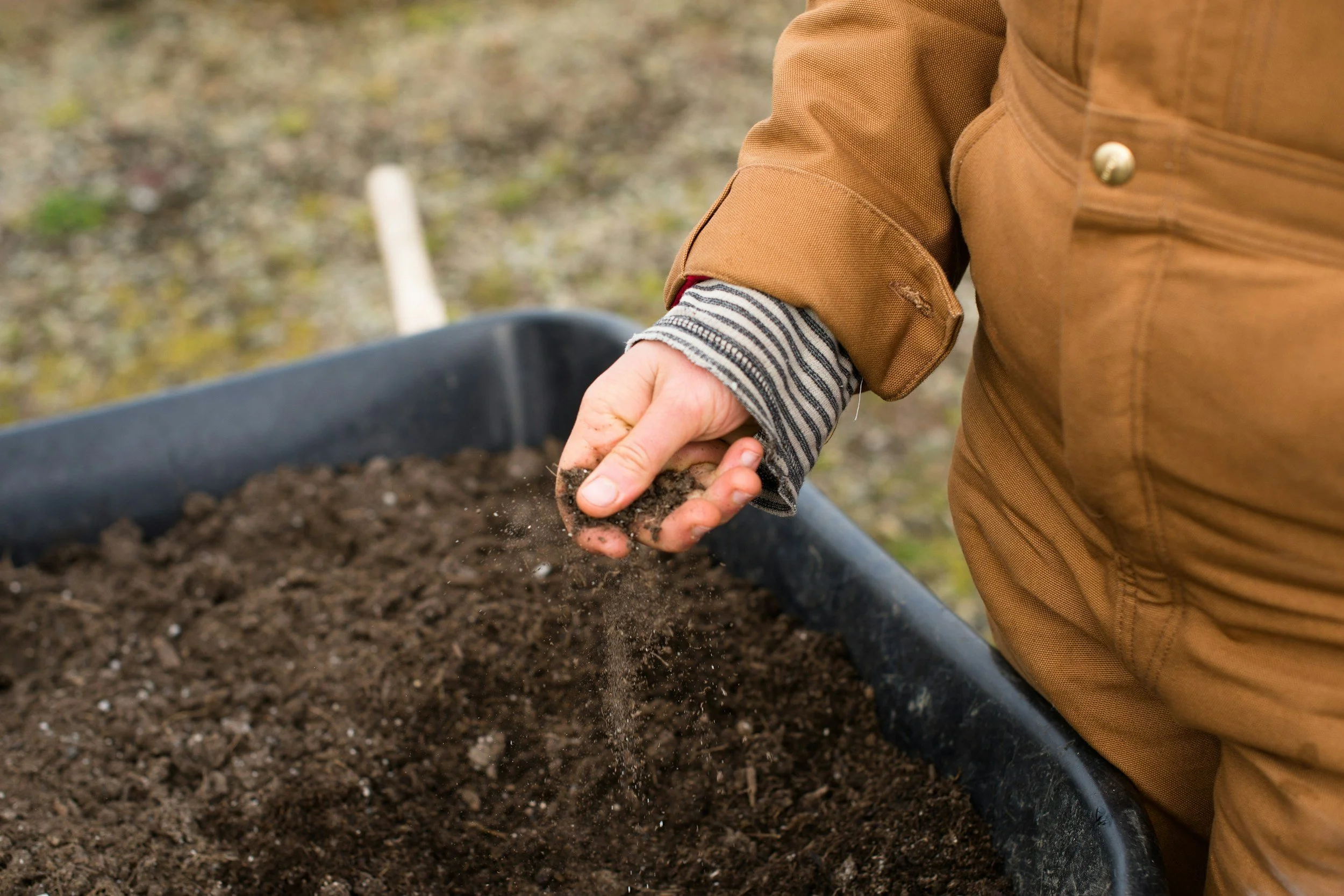
Organic matter is the engine that drives soil health. It feeds soil life and gives your soil the ability to hold water, release nutrients, and support deep roots. A garden with high organic matter feels alive: spongy to the touch, teeming with earthworms, and dark as chocolate.
The easiest way to build organic matter is through compost. Applying a layer of finished compost each year feeds microbes and increases the soil’s capacity to retain water and nutrients. Shredded leaves — often free if you collect them from your yard — are another excellent source. If you leave them whole, they can mat and repel water; but if shredded, they integrate more smoothly and break down faster.
One misconception many gardeners have is that compost instantly ‘fixes’ everything. Compost helps a lot, but it works with soil biology over time. A single application won’t magically correct compaction or deeply embedded nutrient imbalances, but when applied consistently year after year, it transforms soil structure and fertility.
Don’t Ignore Compaction and Drainage
Healthy soil is not just about chemistry; it’s also about physics.
Compaction squeezes out the air in soil. Plants need as much air as water, especially around their roots. In compacted soil, roots struggle to grow, water doesn’t infiltrate well, and the garden becomes prone to both drought stress and waterlogging.
A simple method to check compaction is to push a screwdriver into moist soil. If it resists like you’re trying to pierce a rock, compaction is a problem. The tool of choice for many sustainable gardeners is a broadfork — a manual implement that gently loosens soil to preserve structure and microbial life. If compaction is severe, raised beds filled with a rich mix of compost and mineral soil can give you immediate improvement.
When soil surface puddles after rainfall, that’s often a sign of poor drainage. In low spots or heavy clay soils, consider creating berms (raised banks or walls made of soil) or raised beds. Avoid tilling when soil is too wet; it can create what farmers call a “pugged” layer: extremely compacted soil that is harder to fix than the original problem.
Feed the Soil Biology, Not Just the Plants
Soil is alive. There are more microbes in a teaspoon of healthy soil than there are people on Earth. Take that in for a minute: soil is not dead matter, but a living organism. The microorganisms found in healthy soil, like bacteria, fungi, protozoa, and nematodes, form a food web that transforms organic matter into plant-available nutrients.
Compost feeds this web. Mulch protects it. When you rely exclusively on synthetic fertilizers, you can disrupt these communities. High levels of soluble nutrients can actually suppress the very organisms that build long-term fertility.
That’s not to say there’s no place for amendments. In some cases, like correcting a documented deficiency in phosphorus or potassium, strategic inputs are useful. But they work best in cooperation with strong soil biology, not in place of it.
University Agricultural Extension resources can explain this shift in perspective: from “feed the plant” to “feed the soil.” Viewing your garden through this ecological lens leads to healthier plants and fewer bad surprises over time.
Rotate Crops, Even in Small Gardens
Crop rotation is sometimes dismissed in hobby gardens because people feel they’re too small to bother. That’s a mistake. Rotation breaks pest and disease cycles, balances nutrient demands, and keeps soil from becoming specialized in one type of cropping system.
Plants in the same botanical family often share pests and nutrient usage patterns. If you planted tomatoes in one bed last year, choosing a non-nightshade crop family like brassicas this spring interrupts insect and disease life cycles. If you grow legumes (peas, beans) one season, follow with heavy feeders like squash or tomatoes the next to take advantage of residual nitrogen.
Rotation is like strategic planning in chess. One thoughtful move can change how the next several turns play out, often for the better.
Cover Crops Are Your Silent Soil Allies
Cover crops, which are sometimes called “green manure,” are one of the most powerful strategies for building soil health. These are plants grown not for harvest but for their soil benefits. Species like crimson clover, hairy vetch, oats and winter rye protect the ground in winter and spring. Winter is an especially good time to let cover crops grow in your garden, and why I recommend winter as the ideal time to plan your edible garden for spring.
Cover crops do many things at once. They hold soil in place, preventing erosion. Their roots break up compacted layers. Many add organic matter quickly. Legume cover crops fix nitrogen, which is like banking fertility for the next crop.
If you seeded a winter cover crop last fall, now is the time to decide how to terminate it. Letting it decompose for a few weeks before planting prevents green stems from stealing nitrogen during decomposition. If you didn’t plant cover crops last autumn, consider planning them into future winter strategies. They’re one of the most cost-effective improvements a home gardener can make.
Season-Beginning Mulch Matters
When spring warmth arrives, mulch becomes more than decoration. It moderates soil temperature and moisture, suppresses weeds, and feeds soil life as it breaks down.
Good mulch like straw, shredded leaves, or well-aged grass clippings keeps a garden stable. Avoid dyed wood chips or landscape bark in vegetable beds; they can interfere with soil biology and decompose slowly. You can also use compost as mulch! Just layer 1-3 inches over your plants or seedlings.
Timing is everything. Applying mulch too early when soil is cold can delay warming, slowing seed germination. A light layer after planting is usually best.
Know What Nutrients Your Garden Really Needs
This is where soil testing pays off. If your lab report shows low phosphorus, using a slow-release source like rock phosphate or bone meal, guided by extension recommendations, can correct that deficit. If potassium is low, kelp meal or greensand are common organic sources.
Jonathan Kemper @unsplash
But adding a broad-spectrum fertilizer blindly is inefficient and sometimes harmful. Too much nitrogen stimulates lush leaf growth but at the expense of fruiting and resilience.
The goal is balance: to provide what is deficient without overloading what is already adequate.
Water with Consistency
Water is the medium that carries nutrients into plant roots. Irregular watering stresses plants and disrupts nutrient uptake. Blossom end rot in tomatoes, for example, is often associated with erratic watering even when calcium levels are adequate.
Before planting, check your watering infrastructure. Irrigation systems should be adjusted and tested. Hoses should be leak-checked. If you don’t have drip irrigation, now might be the year to install it. Drip systems deliver water directly to the root zone where plants need it, reducing waste and soil surface crusting.
like this? please pin!
Soil Health Is a Long Game
Spring planting is exciting, but the work you do now determines whether that excitement turns into abundant rows or disappointing yields. Healthy soil doesn’t happen overnight. It’s the result of deliberate decisions: testing, amendment based on data, organic matter buildup, structural improvement, and strategic planting. Keeping a detailed garden journal with this information can also make caring for your garden and managing any problems before they multiply a lot easier.
Every season builds on the last. Improve your soil a little each year, and cumulative gains will transform your garden.
Start with the soil: not just because it’s foundational, but because it’s alive with potential. When soil thrives, your garden will too.
You may also be interested in…



Healthy soil is far more than dirt. Beneath the surface of every productive garden lies a complex ecosystem of microorganisms that help plants grow, resist disease, and access nutrients. Among the most important of these organisms are mycorrhizal fungi, microscopic soil fungi that form beneficial partnerships with plant roots.