



How Route Planning Supports Greener Operations
/Transportation efficiency has a direct effect on the environmental footprint of delivery, service, and field operations. Extra mileage, vehicle idling, poorly sequenced stops, failed deliveries, and partially utilized vehicles all consume energy without adding customer value.
Route planning gives businesses a practical way to reduce that waste. Instead of treating sustainability as a separate initiative, operators can use the same routing decisions that control cost and service performance to reduce unnecessary vehicle activity.
For logistics managers, sustainability leaders, fleet operators, and growing businesses, the key is to connect route planning with measurable operational data.

lucas clarysse @unsplash
Reduce Unnecessary Vehicle Miles
The most direct benefit of route planning is reducing avoidable distance between stops.
A manually planned route may follow the order in which jobs were received rather than the most efficient geographic sequence. Drivers can end up crossing the same area repeatedly, backtracking between neighborhoods, or returning toward a depot unnecessarily.
A digital route maker can organize multiple stops into a more efficient sequence before a vehicle leaves. Spoke's current free Delivery Planner, for example, is designed to optimize multi-stop routes for drivers and small teams.
Reducing route distance can lower fuel or electricity consumption while also decreasing the amount of time vehicles spend operating.
Plan Routes Around Real Operating Constraints
The shortest route is not automatically the greenest route.
A route that ignores customer opening hours, vehicle capacity, service duration, loading restrictions, or driver schedules may create failed stops and repeat journeys.
Better planning considers the conditions required for successful completion.
Capture the Right Routing Data
Useful route inputs include:
Customer delivery windows
Expected service time
Vehicle capacity
Driver start and end points
Depot locations
Pickup and delivery dependencies
Vehicle restrictions
Priority stops
The more accurately these variables represent the real operation, the less likely drivers are to make unplanned return trips.
Reduce Idling and Waiting Time
Vehicle emissions are influenced by more than mileage. Time spent waiting with an engine running can also add avoidable fuel consumption.
Routing should therefore be coordinated with warehouse, customer, and service schedules.
A delivery vehicle arriving 30 minutes before a receiving dock opens may spend that time parked or idling. A technician arriving before a customer is available can create a similar problem.
Include realistic arrival windows and service durations when planning routes. Where possible, coordinate departure times with confirmed customer availability.
The broader goal should be to embed sustainability into day-to-day operations rather than treating environmental goals as separate from normal business processes.
Improve Vehicle Utilization
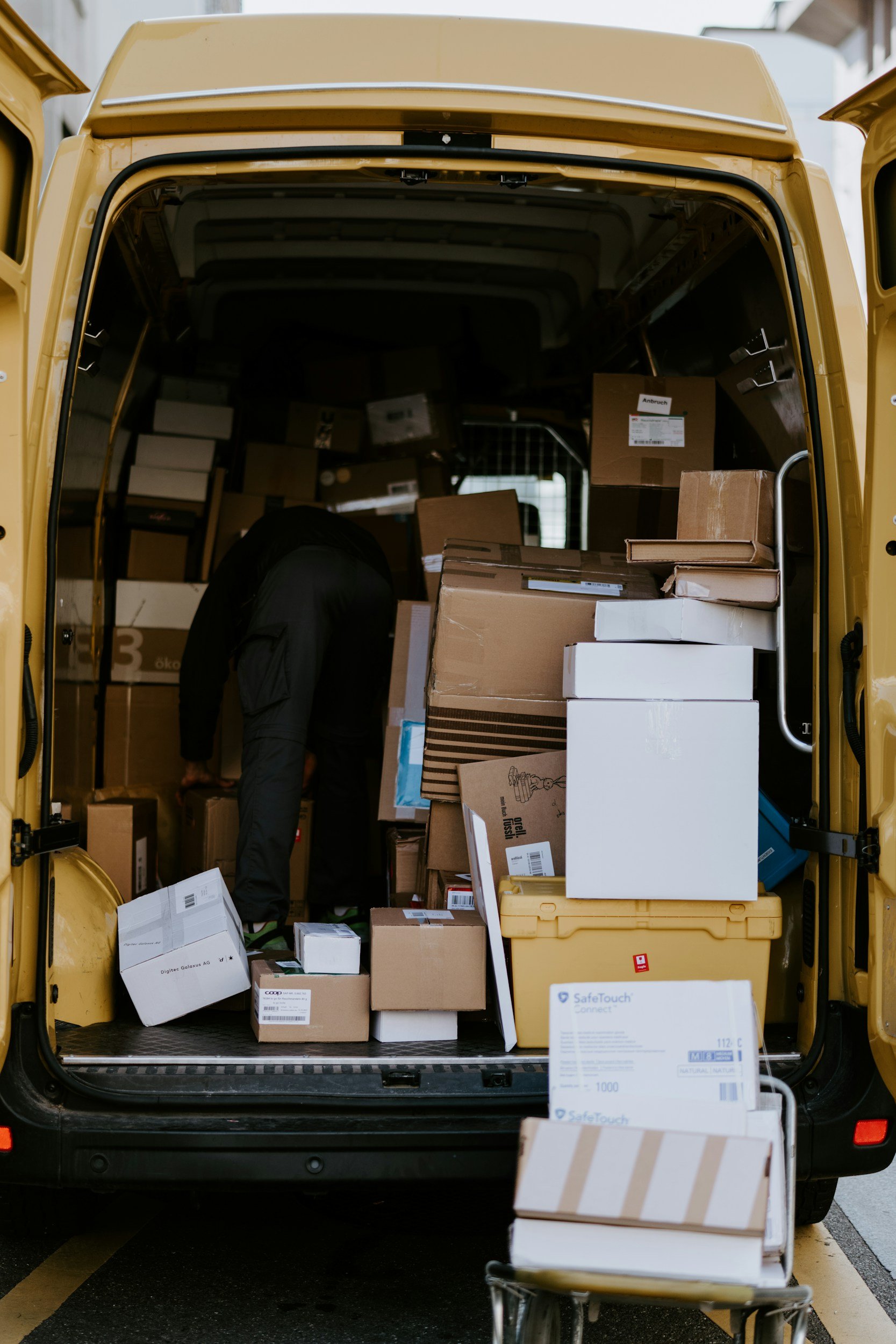
Sending several lightly loaded vehicles into the same area can increase energy use unnecessarily.
Route planning can help operations teams combine compatible stops while respecting payload, volume, time, and service constraints.
Claudio Schwarz @unsplash
For delivery businesses, this might mean consolidating orders geographically. Field service companies can group jobs by territory and technician capability.
Higher utilization does not mean filling every vehicle to its physical limit. The objective is to reduce unnecessary trips while maintaining enough capacity to complete the route reliably.
Lower the Risk of Failed Deliveries
A failed delivery creates more than a customer-service problem. It may require another vehicle trip to the same location.
Address quality should therefore be part of sustainable routing.
Validate customer addresses before dispatch and capture building-specific information such as gate codes, loading entrances, unit numbers, parking restrictions, and preferred delivery times.
Investigate Repeat Failure Points
Track locations where drivers repeatedly encounter:
Incorrect coordinates
Inaccessible entrances
Customer absence
Limited receiving hours
Parking problems
Security restrictions
Correcting one recurring location problem can prevent repeated wasted journeys over the course of a year.
Use Route Data to Support Fleet Electrification
Electric vehicles introduce additional planning variables, including battery range, charging location, charging duration, payload, weather, and route profile.
Route data can help businesses determine which existing journeys are realistic candidates for electrification.
Instead of replacing vehicles first and solving operational problems later, analyze route distance, daily mileage variation, depot return patterns, dwell time, and load requirements.
Short, predictable routes that regularly return to a depot may offer different electrification opportunities from long-distance routes with highly variable schedules.
This turns route planning data into an input for fleet investment decisions.
Compare Planned and Actual Routes
A route can look efficient when planned but perform differently on the road.
Compare planned distance and duration with actual results. Large recurring differences may indicate unrealistic service times, inaccurate mapping, congestion patterns, customer access issues, or driver deviations.
This information should feed back into future planning.
If one delivery zone consistently takes 20 percent longer than expected, update the model rather than continuing to create schedules based on inaccurate assumptions.
Measure Environmental Performance Alongside Cost
Businesses need consistent metrics if route planning is going to support sustainability targets.
Do not measure only total fuel consumption. Fuel use can increase simply because the company is completing more work.
Normalize performance against business activity.
Useful indicators include:
Miles per completed delivery
Fuel consumed per route
Energy used per stop
Failed delivery percentage
Vehicle utilization
Idle time per shift
Planned versus actual mileage
Emissions per delivery or service call
Credible sustainability strategies depend on measurable goals like these and their integration with business operations.
Avoid Optimizing One Metric in Isolation
Reducing mileage is useful, but it should not create another form of operational waste.
An aggressive mileage-minimization strategy could produce overloaded schedules, employee overtime, late customer visits, or repeated failed stops.
Route planning should balance distance with service reliability, vehicle utilization, employee hours, and customer requirements.
Sustainable operations are more durable when environmental improvements also make economic and operational sense. This will ensure that efficiency and sustainability reinforce one another as they are integrated into business models.
Markus Winkler @unsplash
Make Route Planning Part of Daily Sustainability
Greener transportation does not always require immediate fleet replacement or major infrastructure investment.
Businesses can begin by improving how existing vehicles are used.
Validate addresses. Sequence stops intelligently. Reduce repeat journeys. Coordinate arrival times. Consolidate compatible work. Measure idle time and compare actual routes with the original plan.
Then use that operational data to guide larger decisions about vehicles, depots, charging infrastructure, delivery zones, and service models.
Route planning supports greener operations because it turns sustainability into a daily logistics decision. When fewer miles, fewer failed stops, and better vehicle utilization also reduce operating costs, environmental performance becomes part of a stronger business process rather than a separate corporate initiative.
About the Author:
James Avery is a content writer with a focus on sustainable business practices, operational efficiency, and technology. He writes about practical ways businesses can reduce waste, improve logistics, and build more efficient operations while supporting their environmental goals.